


FX tracing (prototype)#
tensordict.prototype.fx.symbolic_trace() traces a
TensorDictModule or a
TensorDictSequential into a torch.fx graph
that you can read and transform. Use it instead of
torch.fx.symbolic_trace(), which raises TypeError: 'TensorDictModule'
object is not subscriptable on a TensorDictModule.
Warning
tensordict.prototype.fx is a prototype. Its API can change without a
deprecation cycle. To make a module faster or to export it, use
torch.compile() or torch.export.export() (see
torch.compile, torch.func, torch.export, and CUDA graphs). If you find a problem, open an issue.
Trace a TensorDictModule#
This example creates a TensorDictModule (see
Modules: TensorDictModule and tensordict.nn), traces it, and prints the graph and the generated
code.
>>> import torch
>>> import torch.nn as nn
>>> from tensordict import TensorDict
>>> from tensordict.nn import TensorDictModule
>>> from tensordict.prototype.fx import symbolic_trace

>>> class Net(nn.Module):
...     def __init__(self):
...         super().__init__()
...         self.linear = nn.LazyLinear(1)
...
...     def forward(self, x):
...         logits = self.linear(x)
...         return logits, torch.sigmoid(logits)
>>> module = TensorDictModule(
...     Net(),
...     in_keys=["input"],
...     out_keys=[("outputs", "logits"), ("outputs", "probabilities")],
... )
>>> graph_module = symbolic_trace(module)
>>> print(graph_module.graph)
graph():
    %tensordict : [num_users=1] = placeholder[target=tensordict]
    %getitem : [num_users=1] = call_function[target=operator.getitem](args = (%tensordict, input), kwargs = {})
    %linear : [num_users=2] = call_module[target=linear](args = (%getitem,), kwargs = {})
    %sigmoid : [num_users=1] = call_function[target=torch.sigmoid](args = (%linear,), kwargs = {})
    return (linear, sigmoid)
>>> print(graph_module.code.strip())
def forward(self, tensordict):
    getitem = tensordict['input'];  tensordict = None
    linear = self.linear(getitem);  getitem = None
    sigmoid = torch.sigmoid(linear)
    return (linear, sigmoid)
A forward pass with each module gives the same outputs:
>>> tensordict = TensorDict({"input": torch.randn(32, 100)}, [32])
>>> module_out = module(tensordict, tensordict_out=TensorDict())
>>> graph_module_out = graph_module(tensordict, tensordict_out=TensorDict())
>>> assert (
...     module_out["outputs", "logits"] == graph_module_out["outputs", "logits"]
... ).all()
>>> assert (
...     module_out["outputs", "probabilities"]
...     == graph_module_out["outputs", "probabilities"]
... ).all()
Trace a TensorDictSequential#
symbolic_trace() also traces a
TensorDictSequential. The whole sequence becomes one
graph: each module gets its inputs from the outputs of the modules before it
in the graph, not from the input TensorDict. This
example traces a sequence of two modules:
>>> import torch
>>> import torch.nn as nn
>>> from tensordict import TensorDict
>>> from tensordict.nn import TensorDictModule, TensorDictSequential
>>> from tensordict.prototype.fx import symbolic_trace

>>> class Net(nn.Module):
...     def __init__(self, input_size=100, hidden_size=50, output_size=10):
...         super().__init__()
...         self.fc1 = nn.Linear(input_size, hidden_size)
...         self.fc2 = nn.Linear(hidden_size, output_size)
...
...     def forward(self, x):
...         x = torch.relu(self.fc1(x))
...         return self.fc2(x)
>>> class Masker(nn.Module):
...     def forward(self, x, mask):
...         return torch.softmax(x * mask, dim=1)
>>> net = TensorDictModule(
...     Net(), in_keys=[("input", "x")], out_keys=[("intermediate", "x")]
... )
>>> masker = TensorDictModule(
...     Masker(),
...     in_keys=[("intermediate", "x"), ("input", "mask")],
...     out_keys=[("output", "probabilities")],
... )
>>> module = TensorDictSequential(net, masker)
>>> graph_module = symbolic_trace(module)
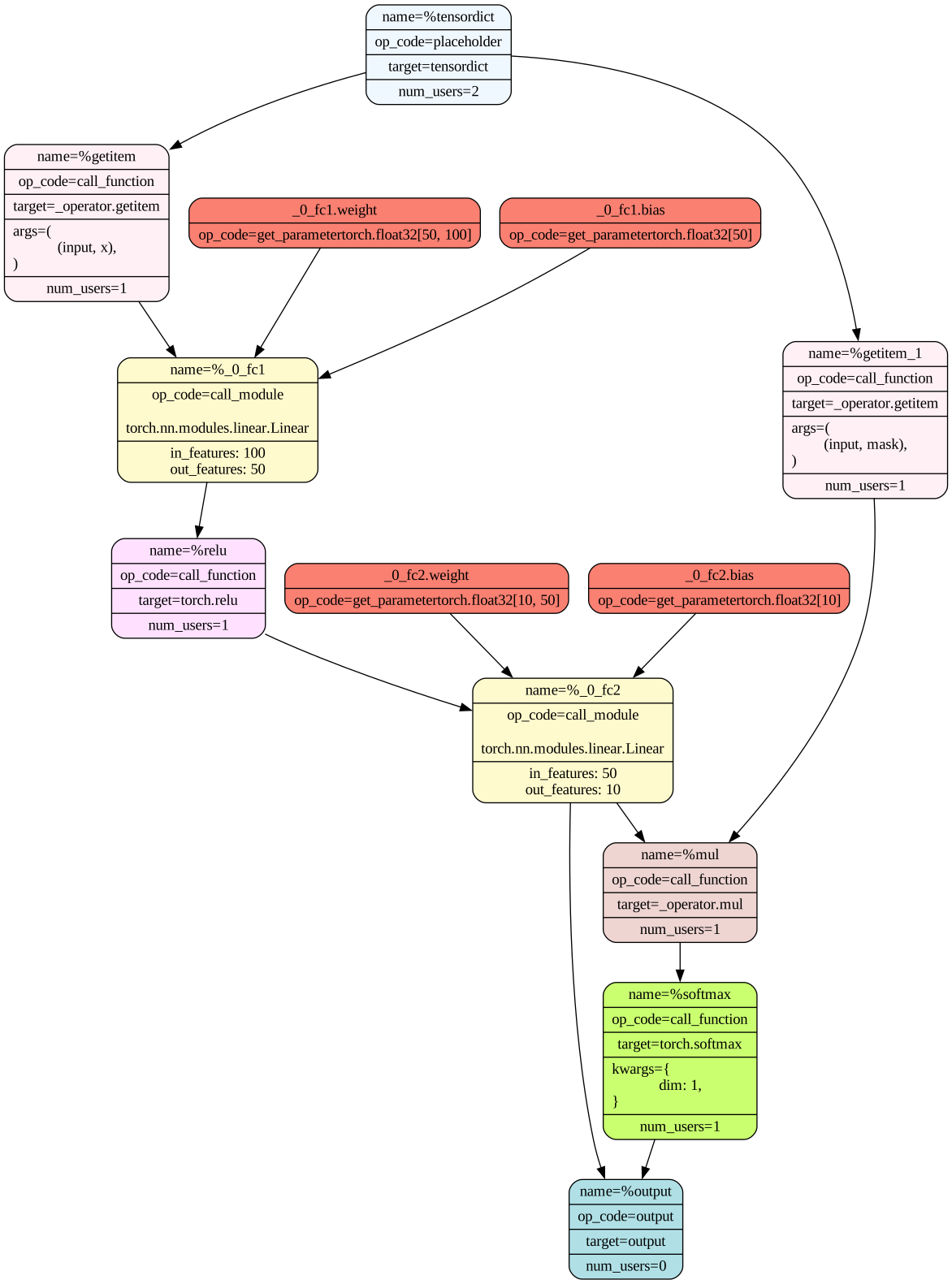
>>> print(graph_module.code.strip())
def forward(self, tensordict):
    getitem = tensordict[('input', 'x')]
    _0_fc1 = getattr(self, "0").module.fc1(getitem);  getitem = None
    relu = torch.relu(_0_fc1);  _0_fc1 = None
    _0_fc2 = getattr(self, "0").module.fc2(relu);  relu = None
    getitem_1 = tensordict[('input', 'mask')];  tensordict = None
    mul = _0_fc2 * getitem_1;  getitem_1 = None
    softmax = torch.softmax(mul, dim = 1);  mul = None
    return (_0_fc2, softmax)
To draw the graph, install the pydot
package and the Graphviz dot program:
>>> import os
>>> import tempfile
>>> from torch.fx.passes.graph_drawer import FxGraphDrawer
>>> g = FxGraphDrawer(graph_module, "sequential")
>>> path = os.path.join(tempfile.mkdtemp(), "graph.svg")
>>> with open(path, "wb") as f:
...     _ = f.write(g.get_dot_graph().create_svg())
The result is this drawing:
Limitations#
The traced module is a TDGraphModule. It differs from the module that it
traces:
It ignores
selected_out_keysof aTensorDictSequential. It writes everyout_keysentry of every module in the sequence, including the intermediate ones, such as("intermediate", "x")above.It takes a tensordict only. A call with tensors as keyword arguments, such as
graph_module(x=torch.randn(32, 100)), raisesTypeError.It writes its outputs into the input tensordict, unless you pass
tensordict_out.
See also#
torch.compile, torch.func, torch.export, and CUDA graphs:
torch.compile()andtorch.export.export()with tensordicts and tensordict modules.Modules: TensorDictModule and tensordict.nn:
TensorDictModuleandTensorDictSequential.The PyTorch documentation of
torch.fx.