TensorDictBase.consolidate#
- TensorDictBase.consolidate(filename: Path | str | None = None, *, num_threads=0, device: device | None = None, non_blocking: bool = False, inplace: bool = False, return_early: bool = False, use_buffer: bool = False, share_memory: bool = False, pin_memory: bool = False, metadata: bool = False) None#
Copies all the leaves into one contiguous storage, and returns a tensordict of views of it.
A consolidated tensordict pickles and moves between devices faster, because its leaves are one block of memory. The result is locked (see
lock_()): you can write into its leaves in place, but you cannot add or remove entries.- Parameters:
filename (Path, optional) – an optional file path for a memory-mapped tensor to use as a storage for the tensordict.
- Keyword Arguments:
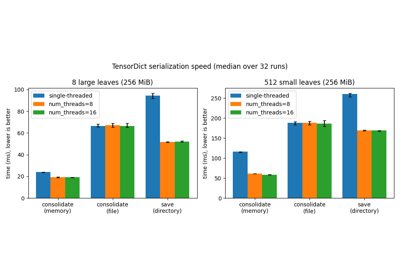
num_threads (integer, optional) – the number of threads to use for populating the storage. The leaves are copied by contiguous chunks of roughly equal byte size, one chunk per thread. When writing to a memory-mapped file with all leaves already on the target device,
num_threadsis ignored and a single fused copy is used instead, as concurrent writes to a fresh file mapping are slower than a sequential one on most filesystems.device (device, optional) – an optional device where the storage must be instantiated.
non_blocking (bool, optional) –
non_blockingargument passed tocopy_().inplace (bool, optional) – if
True, the resulting tensordict is the same asselfwith updated values. Defaults toFalse.return_early (bool, optional) – if
Trueandnum_threads>1, the method will return aTensorDictFuturewhile the copies keep running in the background. The consolidated tensordict can be queried usingfuture.result(). Incompatible withuse_buffer=Trueandnon_blocking=True. Defaults toFalse.use_buffer (bool, optional) – if
Trueand a filename is passed, an intermediate local buffer will be created in shared memory, and the data will be copied at the storage location as a last step. This may be faster than writing directly to a distant physical memory (e.g., NFS). Defaults toFalse.share_memory (bool, optional) – if
True, the storage will be placed in shared memory. Defaults toFalse.pin_memory (bool, optional) – whether the consolidated data should be placed in pinned memory. Defaults to
False.metadata (bool, optional) – if
True, the metadata will be stored alongside the common storage. If a filename is provided, this is without effect. Storing the metadata can be useful when one wants to control how serialization is achieved, as TensorDict handles the pickling/unpickling of consolidated TDs differently if the metadata is or isn’t available.
Note
If the tensordict is already consolidated, all arguments but
filenameare ignored andselfis returned. Callcontiguous()to re-consolidate.Note
The file written with
filenameis a snapshot of the batch sizes and names at the time of the call:from_consolidated()reads them back from it. The leaves are views into the file, so in-place writes into them reach it (unlessuse_buffer=True), but settingbatch_sizeornameslater does not. Callconsolidate(filename=filename)again on the result to write the current ones into the file. Another file name writes nothing:td.contiguous().consolidate(filename=other)writes a new file. Nothing is written either if the file has been deleted or replaced, or has changed size, since this tensordict was written to it.Note
A pickle (or
torch.save(),send(),broadcast()) of a consolidated tensordict is rebuilt from metadata recorded here. Settingbatch_sizeornameson the consolidated tensordict updates that metadata; setting them directly on a nested tensordict, as intd["nested"].batch_size = ..., may not. Callconsolidate()again afterwards: on a consolidated tensordict, it writes the current batch sizes and names into that metadata.Examples
>>> import pickle
>>> import torch
>>> from tensordict import TensorDict
>>> data = TensorDict({"a": torch.zeros(()), "b": {"c": torch.zeros(())}})
>>> data_consolidated = data.consolidate()
>>> # All the leaves share one storage.
>>> assert torch.tensor([
...     v.untyped_storage().data_ptr() for v in data_consolidated.values(True, True)
... ]).unique().numel() == 1
>>> data_consolidated.is_consolidated(), data_consolidated.is_locked
(True, True)
>>> # A consolidated tensordict pickles as one buffer.
>>> restored = pickle.loads(pickle.dumps(data_consolidated))
>>> (restored == data).all()
True
Every tensordict class and every tensorclass has this method. For the other methods, see Methods by task.