Cross-stream memory management: wait_event instead of record_stream
TL;DR – The CUDA caching allocator only knows which stream a tensor was allocated on. When a producer stream allocates a buffer and a consumer stream reads it, keep a Python reference to the buffer and record a CUDA event on the consumer, then make the producer stream
wait_eventon it before you drop the reference. Don’t reach forTensor.record_stream: it’s correct, but it hands memory reuse to the allocator’s event polling, which makes peak memory depend on how far the CPU runs ahead.
Overlapping communication with compute comes down to a producer and a consumer on two CUDA streams. In FSDP2’s forward pass, the all-gather stream (the producer) fetches each layer’s full parameters, and the compute stream (the consumer) runs forward on them. While compute runs layer 1, the all-gather for layer 2 is already in flight, so communication hides behind compute.

Getting this overlap is easy. Getting it without corrupting memory, and
without making memory usage unpredictable, takes a little care. This post walks
through the options on a single GPU, with no torch.distributed involved,
then shows how FSDP2 uses the recommended pattern. The same reasoning applies
to anything else that moves data on a side stream, such as activation
offloading with separate H2D/D2H streams.
The full runnable script is at the end of this post. In every figure, the top lanes are CUDA streams and the bottom lanes are memory blocks. Color identifies the memory block a kernel writes or reads.
Streams, events, and the caching allocator
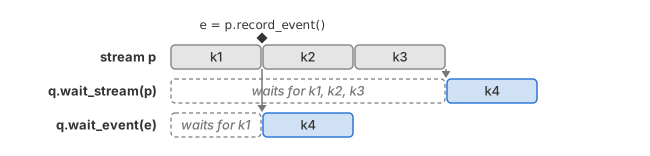
A CUDA stream is a FIFO queue of GPU work. Work on one stream runs in order; work on different streams may overlap. Two primitives order work across streams, and both are GPU-side: the CPU never blocks on them:
s.wait_stream(other): work enqueued onsfrom now on waits for everything currently enqueued onother.s.wait_event(e): finer-grained. Work enqueued onsfrom now on waits for the single point on another stream wheree = other.record_event()was recorded.
The CUDA caching allocator
tags every block with the stream it was allocated on, and only hands a
freed block to later allocations on that same stream. When you del a
tensor, the allocator reasons: “every kernel on the allocation stream that
touches this block was enqueued before the del, so any kernel enqueued later
on that stream, which is the only stream that can get this block, runs after
them.” That argument holds within a single stream and says nothing about
other streams. The allocator has no idea that another stream is still
reading the block.
The bug: the allocator only sees one stream
Here is the naive pipeline. The producer “all-gathers” each layer’s
parameters on ag_stream (simulated with torch.full), and the consumer runs
a matmul on the default stream. wait_stream makes sure forward starts after
the all-gather that produced its parameters.
prev_params = all_gather(ag_stream, layer_id=1)

for layer_id in range(2, NUM_LAYERS + 1):
    default.wait_stream(ag_stream)              # fwd L waits for AG L
    result = forward(prev_params, x, layer_id - 1)

    del prev_params                             # matmul is still running!

    prev_params = all_gather(ag_stream, layer_id)
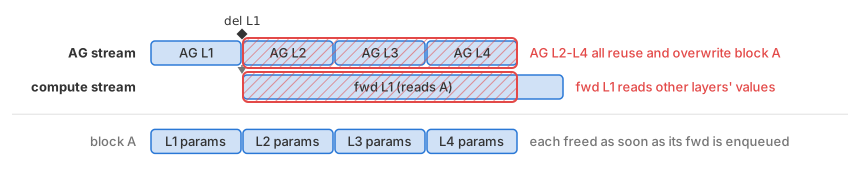
del prev_params runs on the CPU right after the matmul is enqueued, long
before it finishes. The block was allocated on ag_stream, so the allocator
checks only ag_stream, decides the block is reusable, and gives it straight
back to the next all-gather. AG L2 lands in block A and overwrites layer 1’s
parameters while fwd L1 is still reading them. So do AG L3 and AG L4,
because nothing orders ag_stream after the compute stream:
This isn’t a theoretical race. On an H100 it corrupts every run:
=== BUGGY: no lifetime management ===
  trial  0: CORRUPT  max_diff=10876.0  (expected 0)
  trial  1: CORRUPT  max_diff=10854.0  (expected 0)
  trial  2: CORRUPT  max_diff=10882.0  (expected 0)
  [FAIL] 50/50 trials corrupted, at most 1 param blocks per run (4 layers)
The correct value per element is HIDDEN * 1 = 4096, and each weight
overwritten by layer k adds k - 1 to it. A max_diff above 2 * 4096 is
only possible if fwd L1 read many weights that AG L4 had already overwritten
(4.0 instead of 1.0).
Whether and how often it corrupts depends on kernel timing, so a bug like this can pass on one GPU or model size and fail on another. Don’t rely on “it passed once”.
The textbook fix: record_stream, and why we avoid it
The API designed for this is
Tensor.record_stream:
tell the allocator that another stream also used the tensor.
    result = forward(prev_params, x, layer_id - 1)
    prev_params.record_stream(default)          # "default also used this block"
    del prev_params
    prev_params = all_gather(ag_stream, layer_id)
It is correct (0/50 trials corrupted). Here’s what happens inside the allocator:
recordStreamaddsdefaultto the block’sstream_usesset.- On
del, becausestream_usesisn’t empty, the block is not freed. Instead,insert_eventsrecords a CUDA event on each recorded stream and parks the block. - Normally, the block returns to the pool only when a later allocation calls
process_events(fromprepare_for_malloc), andcudaEventQueryreports that the event has completed.
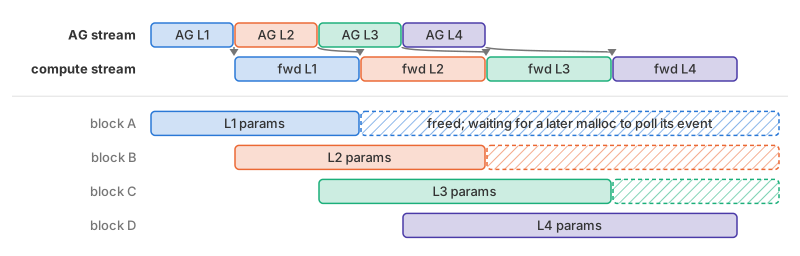
So reuse is no longer decided by the stream order you wrote. It’s decided by whether the GPU happens to have finished by the time the CPU asks for its next allocation. In a healthy pipeline the CPU runs ahead of the GPU, so the answer is usually “not yet”:
=== RECORD_STREAM: correct, allocator polls events ===
  [PASS] 0/50 trials corrupted, at most 4 param blocks per run (4 layers)
Four layers, four blocks. The CPU enqueued all four all-gathers before fwd L1 finished, so every allocation found the previous block’s event still
pending and carved out a fresh one. The number of live buffers is bounded by
how far the CPU runs ahead, not by the two-deep pipeline you designed.
This leads to three practical problems:
- Peak memory is nondeterministic. It changes with CPU speed, kernel
timing, and anything else that shifts the race. FSDP1 frees its unsharded
parameters
with
record_stream, and ships a CPU-side “rate limiter” (limit_all_gathers=True, on by default) that bounds the growth by blocking the CPU thread, capping all-gathered memory at two FSDP instances. - Hidden syncs under memory pressure. Blocks parked on events can’t be
reused, so you run out of cached memory sooner. If no cached block fits and
cudaMallocfails, the allocator’s OOM-retry path callsrelease_cached_blocks, which blocks the CPU on every outstandingrecord_streamevent (cudaEventSynchronize) before it can reclaim those blocks. - It’s easy to miss a stream. Correctness depends on every consumer stream being recorded, and nothing in the code tells you when one is missing.
The
record_stream docstring
says the same thing and points to the alternative:
You can safely use tensors allocated on side streams without
record_stream; you must manually ensure that any non-creation stream uses of a tensor are synced back to the creation stream before you deallocate the tensor.
record_stream still has its place: a one-off handoff in a cold path, or a
library that returns a side-stream tensor to callers who shouldn’t have to
think about streams. For a steady-state pipeline where you own the whole
lifetime, sync back to the creation stream yourself. The next two sections
show how.
Fix 1: stall the producer with wait_event
The direct way to “sync back to the creation stream” is to record an event
after forward and make ag_stream wait on it before the block can be handed
out again:
    result = forward(prev_params, x, layer_id - 1)
    fwd_done = default.record_event()

    ag_stream.wait_event(fwd_done)              # 1. order ag_stream after fwd
    del prev_params                             # 2. only then release the block
    prev_params = all_gather(ag_stream, layer_id)
This is correct and uses exactly one block. On the CPU, the next all-gather
gets the same address immediately. That’s fine: its kernel is queued behind
the wait_event, so it can’t write until fwd L1 is done. But it serializes
the pipeline. AG L2 can’t start until fwd L1 finishes, so the compute
stream sits idle waiting for every all-gather:

The invariant. Every allocation that could be handed this block runs on
the block’s allocation stream, so it’s enough that the wait_event is
enqueued on the allocation stream before the block is released. Put
wait_event before del, not after. If you del first, any allocation
that sneaks in between (a hook, another module, another library) can get the
block, and its kernels won’t be ordered after the consumer.
Fix 2 (recommended): keep a reference, defer the wait_event
To keep the overlap, don’t release layer 1’s block when you’re done
enqueueing its forward. Keep a Python reference to it. While that reference
is alive, the allocator can’t recycle the block, so AG L2 gets a
different block and starts right away. Release L1 one step later, again
with wait_event first:
keepalive, keepalive_event = None, None
prev_params = all_gather(ag_stream, layer_id=1)

for layer_id in range(2, NUM_LAYERS + 1):
    if keepalive is not None:
        ag_stream.wait_event(keepalive_event)   # 1. order ag_stream after fwd
        del keepalive                           # 2. only then release the block

    default.wait_stream(ag_stream)
    result = forward(prev_params, x, layer_id - 1)
    fwd_done = default.record_event()

    keepalive, keepalive_event = prev_params, fwd_done   # don't free yet
    prev_params = all_gather(ag_stream, layer_id)        # gets a different block
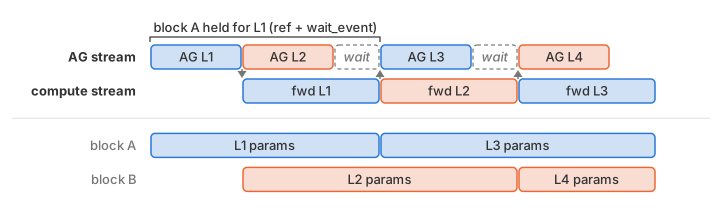
The producer only waits right before it reuses block A for AG L3, and by
then fwd L1 is usually finished or close to it. The compute stream never
waits for buffer reuse. It only waits for the all-gather it actually needs,
and that wait is hidden as long as each all-gather is shorter than a forward.
The cost is explicit and
fixed: one extra buffer buys the overlap, and the two blocks alternate:
=== PIPELINED: keep ref + wait_event ===
  [PASS] 0/50 trials corrupted, at most 2 param blocks per run (4 layers)
This generalizes to deeper pipelines: to allow N buffers in flight, keep N references in a queue and wait-then-drop the oldest. The memory bound is a number you chose, not an outcome of CPU run-ahead.
| Approach | Correct | Producer overlaps consumer | Param blocks (demo, 4 layers, max per run) | Block reuse is decided by |
|---|---|---|---|---|
| No lifetime management | ✗ | ✓ | 1 | nothing (it’s a race) |
record_stream | ✓ | ✓ | 4, grows with CPU run-ahead | allocator polling events on later mallocs |
Stall: wait_event | ✓ | ✗ | 1 | stream order |
Keepalive + wait_event | ✓ | ✓ | 2, fixed by design | stream order + your reference |
How FSDP2 uses this
FSDP2 creates four side streams in
FSDPCommContext.lazy_init,
all_gather_copy_in_stream, all_gather_stream, reduce_scatter_stream
and all_reduce_stream, which together with the compute stream make five.
On CUDA, FSDP2 never calls record_stream. Cross-stream buffers are kept alive
by references and synced back to their allocation stream with wait_event or
wait_stream. The two handoffs that need overlap keep their keepalive in
these tuples, which are exactly “a reference plus an event”:
class AllGatherState(NamedTuple):
    all_gather_result: AllGatherResult
    event: torch.Event | None  # all-gather copy-out

class ReduceScatterState(NamedTuple):
    reduce_scatter_input: torch.Tensor
    event: torch.Event | None  # reduce-scatter event
    allocation_stream: torch.Stream  # Owns the input allocation
    param_group: FSDPParamGroup  # Identifies the owning FSDP root
Forward: copy-in → all-gather → copy-out
Each layer’s unshard runs in three stages on three streams:
- Copy the local shards into one flat buffer on the copy-in stream.
- All-gather in place on the all-gather stream. The all-gather input is a view of its output, so this is one allocation, made on the copy-in stream.
- Copy out into the unsharded parameters on the compute stream, right before forward.
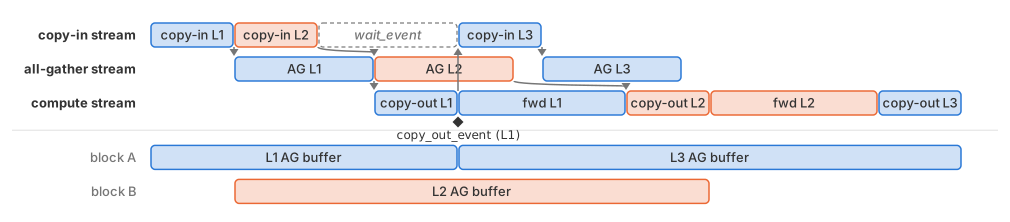
The all-gather buffer is produced on the copy-in stream and last read by the
copy-out on the compute stream, so it’s a producer-consumer handoff. In
wait_for_unshard,
FSDP2 records all_gather_copy_out_event after the copy-out and saves
AllGatherState(all_gather_result, event) as the keepalive instead of
freeing the buffer. When the next layer reaches wait_for_unshard, which is
after its own copy-in has already allocated a different block,
release_all_gather_state_for_comm_reuse
makes both all-gather streams wait_event on the saved event and only then
drops the reference. Since input and output share one allocation, one event
covers both. (The figure only draws the copy-in stream’s wait. The all-gather
stream’s wait is enqueued after AG L2, so by the time it runs it’s already
satisfied.) This is the keepalive pattern with the copy-in stream as the
allocation stream. (See also
Note: Overlapping all-gather copy-in and all-gather.)
Backward: reduce-scatter in the other direction
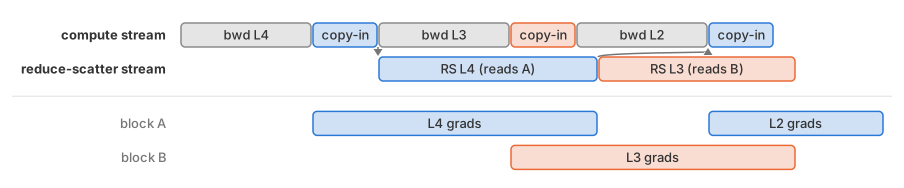
In backward the roles flip. The reduce-scatter input is
allocated on the compute stream
(the producer, which copies gradients into it) and read by the reduce-scatter
on reduce_scatter_stream (the consumer), which records reduce_scatter_event.
FSDP2
appends a ReduceScatterState
holding the input, the event, and the allocation stream. When a later module’s
post-backward needs room, it
pops the oldest state,
calls allocation_stream.wait_event(event), and only then does del oldest.
This is also the “N buffers in flight” generalization in practice. By default
FSDP2 keeps one reduce-scatter input alive. As in Fix 1 there’s a single
buffer, but the wait is deferred to the next module’s post-backward, just
before L3’s gradients are copied into block A. So bwd L3 still overlaps
RS L4, and the compute stream stalls only when RS L4 takes longer than
bwd L3:

FSDPModule.set_reduce_scatter_max_input_buffers(2) (experimental) turns it
into Fix 2. L3’s copy-in gets a second block, and by the time block A is
reused for L2, the wait_event on RS L4 is typically already satisfied.
The cost is one extra reduce-scatter input buffer, a known amount of memory:
Checklist
When a buffer crosses streams:
- Name the allocation stream. That is the only stream whose later allocations can reuse the block, and so the only stream that needs to be ordered.
- Record an event on the consumer after its last use of the buffer.
- Hold a Python reference (keepalive) for as long as you want the producer to keep running ahead.
wait_eventon the allocation stream, thendel, in that order.- Choose how many buffers may be in flight. One means stall, two means ping-pong, N means a queue. Make it a number, not a side effect of CPU run-ahead.
Appendix: the demo script
cross_stream_demo.py (single GPU, no torch.distributed)
"""
Producer-consumer pipelining across CUDA streams — single-GPU demo.

Simulates FSDP2's all-gather → forward pipeline: a producer stream
"fetches" each layer's parameters while a consumer stream runs forward
compute (matmul) on the previous layer's parameters.

Run:  python cross_stream_demo.py
Requires: 1 CUDA GPU.
"""
import torch

HIDDEN = 4096
BATCH = 4096
PARAM_SIZE = HIDDEN * HIDDEN  # 16M floats = 64 MB
NUM_LAYERS = 4


# Addresses of every all-gather output, to count how many distinct blocks
# a run uses
param_ptrs: list[int] = []


def all_gather(stream: torch.cuda.Stream, layer_id: int) -> torch.Tensor:
    """Simulate AG: allocate and fill a param buffer on `stream`."""
    with torch.profiler.record_function(f"AG L{layer_id}"):
        with torch.cuda.stream(stream):
            params = torch.full((PARAM_SIZE,), float(layer_id), device="cuda")
    param_ptrs.append(params.data_ptr())
    return params


def forward(params: torch.Tensor, x: torch.Tensor, layer_id: int) -> torch.Tensor:
    """Simulate forward: matmul with the layer's weight matrix."""
    with torch.profiler.record_function(f"fwd L{layer_id}"):
        weight = params.view(HIDDEN, HIDDEN)
        return x @ weight


def check_results(results: list[tuple[torch.Tensor, int]]) -> float:
    max_diff = 0.0
    for result, layer_id in results:
        expected = float(HIDDEN) * layer_id
        max_diff = max(max_diff, (result - expected).abs().max().item())
    return max_diff


# ---------------------------------------------------------------------------
# Buggy: no lifetime management
# ---------------------------------------------------------------------------

def buggy(x: torch.Tensor) -> float:
    ag_stream = torch.cuda.Stream()
    default = torch.cuda.default_stream()
    results = []

    # Prefetch L1
    prev_params = all_gather(ag_stream, layer_id=1)

    for layer_id in range(2, NUM_LAYERS + 1):
        # Forward previous layer (enqueue only, no CPU sync)
        default.wait_stream(ag_stream)
        result = forward(prev_params, x, layer_id - 1)
        results.append((result, layer_id - 1))

        # Free previous — matmul still running on GPU
        del prev_params

        # Prefetch next — may reuse freed block while matmul reads it
        prev_params = all_gather(ag_stream, layer_id)

    # Last layer
    default.wait_stream(ag_stream)
    result = forward(prev_params, x, NUM_LAYERS)
    results.append((result, NUM_LAYERS))
    del prev_params

    torch.cuda.synchronize()
    return check_results(results)


# ---------------------------------------------------------------------------
# Stall: the producer waits for each forward before reusing the block
# ---------------------------------------------------------------------------

def stall_producer(x: torch.Tensor) -> float:
    ag_stream = torch.cuda.Stream()
    default = torch.cuda.default_stream()
    results = []

    prev_params = all_gather(ag_stream, layer_id=1)

    for layer_id in range(2, NUM_LAYERS + 1):
        default.wait_stream(ag_stream)
        result = forward(prev_params, x, layer_id - 1)
        fwd_done = default.record_event()
        results.append((result, layer_id - 1))

        # Stall: AG waits for forward before the block can be reused
        ag_stream.wait_event(fwd_done)
        del prev_params
        prev_params = all_gather(ag_stream, layer_id)

    default.wait_stream(ag_stream)
    result = forward(prev_params, x, NUM_LAYERS)
    fwd_done = default.record_event()
    results.append((result, NUM_LAYERS))
    ag_stream.wait_event(fwd_done)
    del prev_params

    torch.cuda.synchronize()
    return check_results(results)


# ---------------------------------------------------------------------------
# Keepalive: hold a Python ref + wait_event before del
# ---------------------------------------------------------------------------

def keep_ref(x: torch.Tensor) -> float:
    ag_stream = torch.cuda.Stream()
    default = torch.cuda.default_stream()
    results = []
    keepalive = None     # previous iteration's params (ref kept alive)
    keepalive_event = None

    prev_params = all_gather(ag_stream, layer_id=1)

    for layer_id in range(2, NUM_LAYERS + 1):
        # Free previous iteration's keepalive (wait_event first, then del)
        if keepalive is not None:
            ag_stream.wait_event(keepalive_event)
            del keepalive

        # Forward current layer
        default.wait_stream(ag_stream)
        result = forward(prev_params, x, layer_id - 1)
        fwd_done = default.record_event()
        results.append((result, layer_id - 1))

        # Don't del prev_params — save as keepalive
        keepalive = prev_params
        keepalive_event = fwd_done

        # Prefetch next — gets DIFFERENT block because keepalive holds ref
        prev_params = all_gather(ag_stream, layer_id)

    # Free last keepalive
    if keepalive is not None:
        ag_stream.wait_event(keepalive_event)
        del keepalive

    # Last layer
    default.wait_stream(ag_stream)
    result = forward(prev_params, x, NUM_LAYERS)
    fwd_done = default.record_event()
    results.append((result, NUM_LAYERS))
    ag_stream.wait_event(fwd_done)
    del prev_params

    torch.cuda.synchronize()
    return check_results(results)


# ---------------------------------------------------------------------------
# record_stream: correct, but reuse is decided by the allocator polling events
# ---------------------------------------------------------------------------

def record_stream(x: torch.Tensor) -> float:
    ag_stream = torch.cuda.Stream()
    default = torch.cuda.default_stream()
    results = []

    prev_params = all_gather(ag_stream, layer_id=1)

    for layer_id in range(2, NUM_LAYERS + 1):
        default.wait_stream(ag_stream)
        result = forward(prev_params, x, layer_id - 1)
        results.append((result, layer_id - 1))

        # Tell the allocator the default stream also used this block
        prev_params.record_stream(default)
        del prev_params

        prev_params = all_gather(ag_stream, layer_id)

    default.wait_stream(ag_stream)
    result = forward(prev_params, x, NUM_LAYERS)
    results.append((result, NUM_LAYERS))
    prev_params.record_stream(default)
    del prev_params

    torch.cuda.synchronize()
    return check_results(results)


# ---------------------------------------------------------------------------
# Runner
# ---------------------------------------------------------------------------

def run_trials(label: str, fn, x: torch.Tensor, trials: int) -> None:
    corrupted = 0
    max_blocks = 0
    for t in range(trials):
        param_ptrs.clear()
        diff = fn(x)
        max_blocks = max(max_blocks, len(set(param_ptrs)))
        if diff > 1e-6:
            corrupted += 1
            if corrupted <= 3:
                print(f"  trial {t:2d}: CORRUPT  max_diff={diff:.1f}  (expected 0)")
    status = "PASS" if corrupted == 0 else "FAIL"
    print(f"  [{status}] {corrupted}/{trials} trials corrupted, "
          f"at most {max_blocks} param blocks per run ({NUM_LAYERS} layers)\n")


if __name__ == "__main__":
    TRIALS = 50

    torch.cuda.synchronize()
    x = torch.ones(BATCH, HIDDEN, device="cuda")
    _w = torch.empty(PARAM_SIZE, device="cuda"); del _w
    torch.cuda.synchronize()

    print(f"Config: HIDDEN={HIDDEN}, BATCH={BATCH}, NUM_LAYERS={NUM_LAYERS}")
    print(f"Expected per element: HIDDEN * layer_id\n")

    print("=== BUGGY: no lifetime management ===")
    run_trials("buggy", buggy, x, TRIALS)

    print("=== RECORD_STREAM: correct, allocator polls events ===")
    run_trials("record_stream", record_stream, x, TRIALS)

    print("=== STALL: wait_event (correct but serialized) ===")
    run_trials("stall", stall_producer, x, TRIALS)

    print("=== PIPELINED: keep ref + wait_event ===")
    run_trials("pipelined", keep_ref, x, TRIALS)
Output on one H100:
Config: HIDDEN=4096, BATCH=4096, NUM_LAYERS=4
Expected per element: HIDDEN * layer_id

=== BUGGY: no lifetime management ===
  trial  0: CORRUPT  max_diff=10876.0  (expected 0)
  trial  1: CORRUPT  max_diff=10854.0  (expected 0)
  trial  2: CORRUPT  max_diff=10882.0  (expected 0)
  [FAIL] 50/50 trials corrupted, at most 1 param blocks per run (4 layers)

=== RECORD_STREAM: correct, allocator polls events ===
  [PASS] 0/50 trials corrupted, at most 4 param blocks per run (4 layers)

=== STALL: wait_event (correct but serialized) ===
  [PASS] 0/50 trials corrupted, at most 1 param blocks per run (4 layers)

=== PIPELINED: keep ref + wait_event ===
  [PASS] 0/50 trials corrupted, at most 2 param blocks per run (4 layers)