# Quantization-Aware Training (QAT)
Quantization-Aware Training (QAT) refers to applying fake quantization during the
training or fine-tuning process, such that the final quantized model will exhibit
higher accuracies and lower perplexities. Fake quantization refers to rounding the float
values to quantized values without actually casting them to dtypes with lower
bit-widths, in contrast to post-training quantization (PTQ), which does cast the
quantized values to lower bit-width dtypes, e.g.:
```
# PTQ: x_q is quantized and cast to int8
# scale and zero point (zp) refer to parameters used to quantize x_float
# qmin and qmax refer to the range of quantized values
x_q = (x_float / scale + zp).round().clamp(qmin, qmax).cast(int8)
# QAT: x_fq is still in float
# Fake quantize simulates the numerics of quantize + dequantize
x_fq = (x_float / scale + zp).round().clamp(qmin, qmax)
x_fq = (x_fq - zp) * scale
```
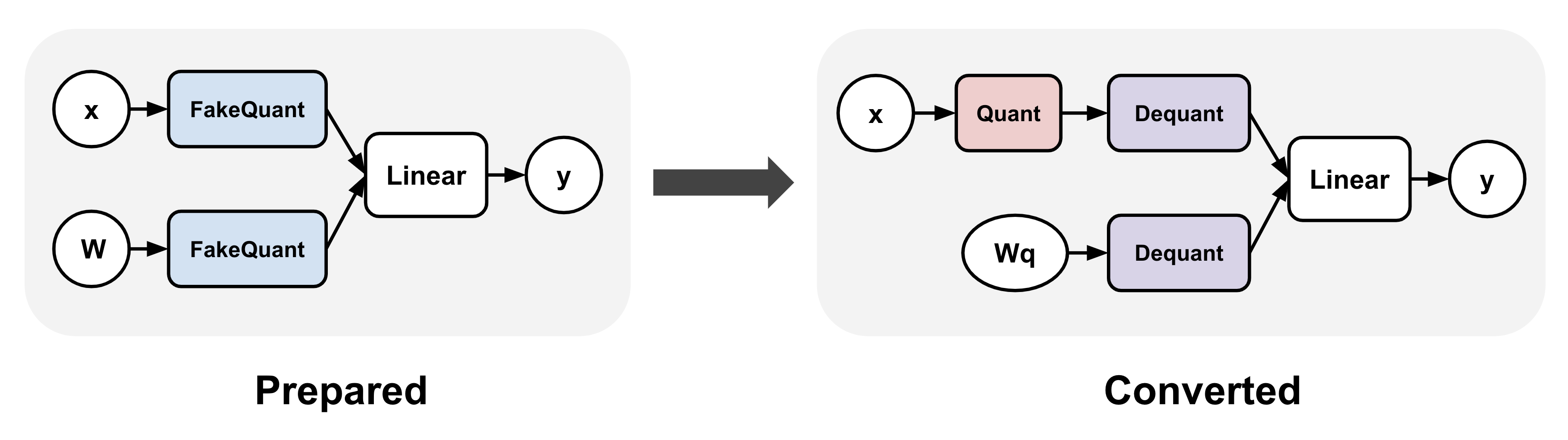
QAT typically involves applying a transformation to your model before and after training.
In torchao, these are represented as the prepare and convert steps: (1) prepare inserts
fake quantize operations into linear layers, and (2) convert transforms the fake quantize
operations to actual quantize and dequantize operations after training, thereby producing
a quantized model (dequantize operations are typically fused with linear after lowering).
Between these two steps, training can proceed exactly as before.
## torchao APIs
torchao currently supports two QAT APIs, one through the [`quantize_`](https://pytorch.org/ao/stable/generated/torchao.quantization.quantize_.html#torchao.quantization.quantize_)
API (recommended) and one through the Quantizer classes (legacy). The `quantize_` API
allows flexible configuration of quantization settings for both activations and weights,
while the Quantizer classes each hardcode a specific quantization setting.
For example, running QAT on a single GPU:
```python
import torch
from torchtune.models.llama3 import llama3
# Set up smaller version of llama3 to fit in a single GPU
def get_model():
return llama3(
vocab_size=4096,
num_layers=16,
num_heads=16,
num_kv_heads=4,
embed_dim=2048,
max_seq_len=2048,
).cuda()
# Example training loop
def train_loop(m: torch.nn.Module):
optimizer = torch.optim.SGD(m.parameters(), lr=0.001, momentum=0.9, weight_decay=1e-5)
loss_fn = torch.nn.CrossEntropyLoss()
for i in range(10):
example = torch.randint(0, 4096, (2, 16)).cuda()
target = torch.randn((2, 16, 4096)).cuda()
output = m(example)
loss = loss_fn(output, target)
loss.backward()
optimizer.step()
optimizer.zero_grad()
```
### quantize_ API (recommended)
The recommended way to run QAT in torchao is through the `quantize_` API.
1. **Prepare:** The main [`QATConfig`](https://docs.pytorch.org/ao/main/generated/torchao.quantization.qat.QATConfig.html)
accepts a post-training quantization (PTQ) config and automatically infers
the corresponding fake quantization configs to use.
2. **Convert:** quantize the model using the base config provided
Currently only the following PTQ base configs are supported:
- [`Int4WeightOnlyConfig`](https://docs.pytorch.org/ao/main/generated/torchao.quantization.Int4WeightOnlyConfig.html)
For example (most use cases):
```python
from torchao.quantization import quantize_, Int4WeightOnlyConfig
from torchao.quantization.qat import QATConfig
model = get_model()
# prepare: swap `torch.nn.Linear` -> `FakeQuantizedLinear`
base_config = Int4WeightOnlyConfig(group_size=32)
quantize_(model, QATConfig(base_config, step="prepare"))
# train
train_loop(model)
# convert: swap `FakeQuantizedLinear` -> `torch.nn.Linear`, then quantize using `base_config`
quantize_(model, QATConfig(base_config, step="convert"))
# inference or generate
```
The `quantize_` API also allows more general quantization settings that
may not have a corresponding PTQ base config, e.g. for experimentation
purposes. Users can specify custom fake quantization configs for activations
and/or weights. For example, the following usage is numerically equivalent
to the above:
```python
from torchao.quantization import quantize_, Int4WeightOnlyConfig
from torchao.quantization.qat import IntxFakeQuantizeConfig, QATConfig
model = get_model()
# prepare: swap `torch.nn.Linear` -> `FakeQuantizedLinear`
activation_config = IntxFakeQuantizeConfig(torch.int8, "per_token", is_symmetric=False)
weight_config = IntxFakeQuantizeConfig(torch.int4, group_size=32)
qat_config = QATConfig(
activation_config=activation_config,
weight_config=weight_config,
step="prepare",
)
quantize_(model, qat_config)
# train
train_loop(model)
# convert: (not shown, same as before)
```
To fake quantize embedding in addition to linear, you can additionally call
the following with a filter function during the prepare step:
```
# First apply linear transformation to the model as above
# Then apply weight-only transformation to embedding layers
# (activation fake quantization is not supported for embedding layers)
qat_config = QATConfig(weight_config=weight_config, step="prepare")
quantize_(m, qat_config, filter_fn=lambda m, _: isinstance(m, torch.nn.Embedding))
```
Quantizer API (legacy)
Alternatively, torchao provides a few hardcoded quantization settings through
the following Quantizers, but these may be removed soon:
- [Int8DynActInt4QATQuantizer](https://docs.pytorch.org/ao/main/generated/torchao.quantization.qat.Int8DynActInt4WeightQATQuantizer.html#torchao.quantization.qat.Int8DynActInt4WeightQATQuantizer) (linear), targeting int8 per-token dynamic asymmetric activation + int4 per-group symmetric weight
- [Int4WeightOnlyQATQuantizer](https://docs.pytorch.org/ao/main/generated/torchao.quantization.qat.Int4WeightOnlyQATQuantizer.html#torchao.quantization.qat.Int4WeightOnlyQATQuantizer) (linear), targeting int4 per-group asymmetric weight using the efficient [int4 tinygemm kernel](https://github.com/pytorch/pytorch/blob/a672f6c84e318bbf455f13dfdd3fd7c68a388bf5/aten/src/ATen/native/cuda/int4mm.cu#L1097) after training)
- [Int4WeightOnlyEmbeddingQATQuantizer](https://docs.pytorch.org/ao/main/generated/torchao.quantization.qat.Int4WeightOnlyEmbeddingQATQuantizer.html#torchao.quantization.qat.Int4WeightOnlyEmbeddingQATQuantizer) (embedding), targeting int4 per-group symmetric weight
For example:
```python
from torchao.quantization.qat import Int8DynActInt4WeightQATQuantizer
qat_quantizer = Int8DynActInt4WeightQATQuantizer(group_size=32)
model = get_model()
# prepare: insert fake quantization ops
# swaps `torch.nn.Linear` with `Int8DynActInt4WeightQATLinear`
model = qat_quantizer.prepare(model)
# train
train_loop(model)
# convert: transform fake quantization ops into actual quantized ops
# swaps `Int8DynActInt4WeightQATLinear` with `Int8DynActInt4WeightLinear`
model = qat_quantizer.convert(model)
# inference or generate
```
To use multiple Quantizers in the same model for different layer types,
users can also leverage the [ComposableQATQuantizer](https://docs.pytorch.org/ao/main/generated/torchao.quantization.qat.ComposableQATQuantizer.html#torchao.quantization.qat.ComposableQATQuantizer)
as follows:
```python
from torchao.quantization.qat import (
ComposableQATQuantizer,
Int4WeightOnlyEmbeddingQATQuantizer,
Int8DynActInt4WeightQATQuantizer,
)
quantizer = ComposableQATQuantizer([
Int8DynActInt4WeightQATQuantizer(groupsize=group_size),
Int4WeightOnlyEmbeddingQATQuantizer(group_size=group_size),
])
# prepare + train + convert as before
model = qat_quantizer.prepare(model)
train_loop(model)
model = qat_quantizer.convert(model)
```
## Axolotl integration
[Axolotl](https://github.com/axolotl-ai-cloud) uses TorchAO to support quantized-aware fine-tuning. You can use the following commands to fine-tune, and then quantize a Llama-3.2-3B model:
```bash
axolotl train examples/llama-3/3b-qat-fsdp2.yaml
# once training is complete, perform the quantization step
axolotl quantize examples/llama-3/3b-qat-fsdp2.yaml
# you should now have a quantized model saved in ./outputs/qat_out/quatized
```
Please see the [QAT documentation](https://docs.axolotl.ai/docs/qat.html) in axolotl for more details.
## Unsloth integration
[Unsloth](https://github.com/unslothai/unsloth) also leverages TorchAO for quantized-aware fine-tuning. Unsloth's QAT support can be used with both full and LoRA fine-tuning. For example:
```python
from unsloth import FastLanguageModel
model, tokenizer = FastLanguageModel.from_pretrained(
"unsloth/Qwen3-4B-Instruct-2507",
max_seq_len = 2048,
dtype = torch.bfloat16,
load_in_4bit = False,
full_finetuning = False,
)
model = FastLanguageModel.get_peft_model(
model,
r = 16,
target_modules = ["q_proj", "k_proj", "v_proj", "o_proj", "gate_proj", "up_proj", "down_proj",],
lora_alpha = 16,
qat_scheme = "int4",
)
```
For a full notebook example, see: https://colab.research.google.com/github/unslothai/notebooks/blob/main/nb/Qwen3_(14B)-Reasoning-Conversational.ipynb. A QAT-specific notebook is coming soon.
torchtune integration (legacy)
torchao QAT is integrated with [torchtune](https://github.com/pytorch/torchtune)
to allow users to run quantized-aware fine-tuning as follows:
```
tune run --nproc_per_node 8 qat_distributed --config llama3/8B_qat_full
```
torchtune also supports a [QAT + LoRA distributed training recipe](https://github.com/pytorch/torchtune/blob/main/recipes/qat_lora_finetune_distributed.py)
that is 1.89x faster and uses 36.1% memory compared to vanilla QAT in our early experiments.
You can read more about it [here](https://dev-discuss.pytorch.org/t/speeding-up-qat-by-1-89x-with-lora/2700):
```
tune run --nnodes 1 --nproc_per_node 4 qat_lora_finetune_distributed --config llama3/8B_qat_lora
```
For more detail, please refer to [this QAT tutorial](https://pytorch.org/torchtune/main/tutorials/qat_finetune.html).
## Evaluation Results
Int4 weight-only QAT + LoRA using a group size of 128, fine-tuned using Unsloth.
Both fine-tuning and evaluation was done on a single H100 GPU using the
[mlabonne/FineTome-100k](https://huggingface.co/datasets/mlabonne/FineTome-100k)
dataset. Learning rate was 2e-5 and batch size was 64 with no gradient accumulation.
```
# gemma3-12b-it
+-------------+-----------------+-----------------+------------+-------------+
| Eval task | bf16 baseline | int4 baseline | int4 QAT | recovered |
+=============+=================+=================+============+=============+
| wikitext | 9.1477 | 9.7745 | 9.5631 | 33.727% |
+-------------+-----------------+-----------------+------------+-------------+
| bbh | 0.8079 | 0.7624 | 0.7831 | 45.495% |
+-------------+-----------------+-----------------+------------+-------------+
# gemma3-4b-it
+-------------+-----------------+-----------------+------------+-------------+
| Eval task | bf16 baseline | int4 baseline | int4 QAT | recovered |
+=============+=================+=================+============+=============+
| wikitext | 12.1155 | 13.247 | 12.797 | 39.770% |
+-------------+-----------------+-----------------+------------+-------------+
| bbh | 0.7074 | 0.6415 | 0.6666 | 38.088 |
+-------------+-----------------+-----------------+------------+-------------+
| gpqa | 0.3232 | 0.3081 | 0.3182 | 66.887% |
+-------------+-----------------+-----------------+------------+-------------+
# Qwen3-4B-Instruct
+-------------+-----------------+-----------------+------------+-------------+
| Eval task | bf16 baseline | int4 baseline | int4 QAT | recovered |
+=============+=================+=================+============+=============+
| mmlu-pro | 0.4909 | 0.4328 | 0.4524 | 33.735% |
+-------------+-----------------+-----------------+------------+-------------+
# Llama3.2-3B
+-------------+-----------------+-----------------+------------+-------------+
| Eval task | bf16 baseline | int4 baseline | int4 QAT | recovered |
+=============+=================+=================+============+=============+
| wikitext | 12.1322 | 13.3459 | 12.8796 | 38.420% |
+-------------+-----------------+-----------------+------------+-------------+
| bbh | 0.5483 | 0.4967 | 0.5174 | 40.116% |
+-------------+-----------------+-----------------+------------+-------------+
| gpqa | 0.3333 | 0.2879 | 0.303 | 33.260% |
+-------------+-----------------+-----------------+------------+-------------+
| mmlu-pro | 0.2771 | 0.2562 | 0.2629 | 32.057% |
+-------------+-----------------+-----------------+------------+-------------+
```
NVFP4 QAT full fine-tuning, fine-tuned using Axolotl on 8x B200 GPUs on the
[yahma/alpaca-cleaned](https://huggingface.co/datasets/yahma/alpaca-cleaned)
dataset. Learning rate was 2e-5 and batch size was 128 for `gemma3-12b-it`
and 32 for `Qwen3-8B`.
```
# gemma3-12b-it
+-------------+-----------------+------------------+-------------+-------------+
| Eval task | bf16 baseline | nvfp4 baseline | nvfp4 QAT | recovered |
+=============+=================+==================+=============+=============+
| bbh | 0.7527 | 0.7068 | 0.7222 | 33.551% |
+-------------+-----------------+------------------+-------------+-------------+
| mmlu-pro | 0.4074 | 0.3621 | 0.3702 | 17.881% |
+-------------+-----------------+------------------+-------------+-------------+
# Qwen3-8B
+-------------+-----------------+------------------+-------------+-------------+
| Eval task | bf16 baseline | nvfp4 baseline | nvfp4 QAT | recovered |
+=============+=================+==================+=============+=============+
| bbh | 0.7771 | 0.7262 | 0.7397 | 26.523% |
+-------------+-----------------+------------------+-------------+-------------+
| mmlu-pro | 0.4929 | 0.4519 | 0.4686 | 40.732% |
+-------------+-----------------+------------------+-------------+-------------+
```
For more details, please refer to [this blog post](https://pytorch.org/blog/quantization-aware-training).